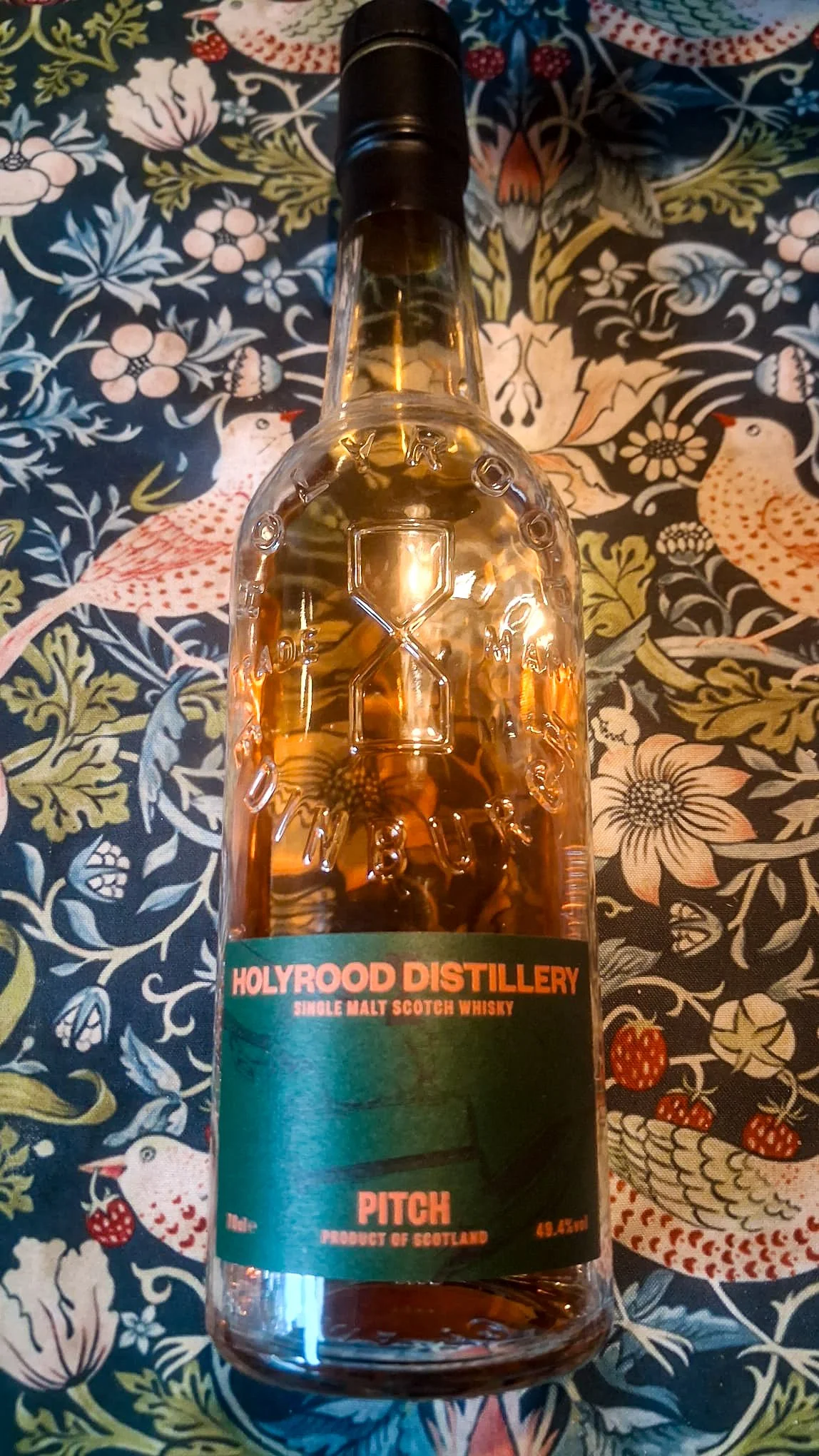
Holyrood Pitch
Official Release | 49.4% ABV
Score: 6/10
Good stuff.
TL;DR
Rough as a belt sander and utterly singular
Take Note
The one thing that has done more than anything else, for both my enjoyment of whisky and the development of my palate, was a decision I took. Very early in my whisky journey, I decided to start taking tasting notes on the expressions that I was buying.
If you’re a regular reader of Dramface then it’s likely that you’re already familiar with the benefits of making tasting notes, but on the off chance that you are not, then I’d urge you to start.
It really is a worthwhile investment of time – one that forces us to pause and think critically and evaluatively about the whiskies that we drink, rather than simply consuming them absent-mindedly. Needless to say, tasting notes also act as a catalyst for the refinement of our palates. They allow us to form points-of-reference, and to identify smells and flavours that we encounter in other food and drink, and relate those smells and flavours to whisky itself.
Tasting notes also do something else, though, other than just sharpening our olfactory senses: in much the same way that keeping a diary provides a chronicle of your journey through life, tasting notes provide a chronicle of our journeys across the whisky landscape. It’s for this reason that I also think it’s important to date your tasting notes, something which, when I first started writing them, I neglected to do.
The reason I bring this up is because, over the summer, I was having a clear out. I came across several books of old tasting notes in a drawer.
Those of you who read Dramface regularly may have noticed that I’ve been absent of late. This isn’t because I haven’t been drinking whisky, but rather because I’d fallen out of the habit of really taking the time to analyse it. Coming across my stash of old tasting notes – whisky journals, if you will – reminded me of the importance of actually taking the time to reflect on the whisky that I’m drinking, rather than simply consuming it. Our relationship with whisky is, after all, like any other relationship: we only get out of it what we put in.
Anyway, among these books was my very first book of notes – a little blue book that I quickly realised was far too small for such a purpose. I hadn’t dated any of the entries – a school boy error, I know – but I’m confident that most of the notes in there were from around 2010, which was around the time that I first started getting really serious about whisky. The reason that I was able to date it so confidently is because of the nature of the expressions I was reviewing. Most of them were supermarket expressions, and those that were more obscure were expressions that have long since been discontinued – Bruichladdich Waves, for instance, and Elijah Craig 12yo. For me, at the time, there were no indy expressions to be found anywhere.
Needless to say, I was intrigued to see what I was drinking back then, so I sat down to read some of the notes that I’d written.
It was, to put it bluntly, fairly cringe-inducing – a bit like reading an old diary, in which your thirteen year old self details the crush he has on the girl he sits next to in science classes at school.
What was specifically cringe inducing was the obvious lack of experience that those notes betrayed, coupled with the misplaced confidence in my own opinions – most of which had been formed from having tasted just a handful of bog-standard bottles, and from watching Ralfy’s nascent YouTube channel and copping some of the language he was using.
What struck me more than anything were the scores though. After a particularly effusive review of Talisker 10, for instance, I concluded with the following: ‘Incredibly classy and sophisticated. Possibly the best balanced whisky I’ve tried. 94/100.’
Yep, you read that right, folks. I gave Talisker’s 10yo 94 out of 100. And as for ‘the best-balanced whisky’ I’d tried – it’s a statement which, in and of itself, would have left any reader who had more than a passing interest in whisky in little to no doubt that I was still pretty new to the whole thing.
Indeed, I’ve had Talisker 10 within the last few years and it was rougher than a high dive into a ball-pit full of shale. No doubt back then, it was perhaps better than it is today – possibly, it may have been rounded out with some older stock, things being as they were in 2010 – but even so, 94/100 for a supermarket whisky that’s not even bottled at 46%? Really?
Then again, perhaps I shouldn’t be so incredulous. After all, we all know that context is everything. In the right company, in the right environment and with the right frame of mind, a mediocre – even subpar – whisky, can really hit the spot. Moreover, I think it speaks to something that’s likely universal when it comes to getting into whisky. Namely, that new experiences in whisky – revelations, or epiphanies, or whatever you want to call them – become harder to come by as we taste more whiskies.
Looking back on those notes, it’s obvious to me that in the early days of my whisky journey, the amber road that I’d embarked upon was replete with new experiences. Take my notes on The Balvenie 14yo Caribbean Rum Cask, for example – big, meaty and powerful – or the now discontinued Bruichladdich Peated – robust and smooth – or even Bowmore’s Small Batch Reserve, which I described (no doubt inaccurately) as very unusual and very complex.
Looking back over those notes, it’s hard not to feel that virtually every bottle I opened contained some sort of new, as-yet-unexplored olfactory awakening. Even Jura’s 12yo Elixir is referred to as ‘complex’.
It’s been a good while since I’ve tried Jura Elixir – or any Jura for that matter – but I doubt that if I did have some to hand right now, I’d characterise it as complex. Passable, okay for the money and perfectly adequate, maybe. But it’s hardly the whisky equivalent of a Rubik’s Cube.
It's easy to be contemptuous, though, especially when it comes to looking back at your formative years. As I write this, I’m listening to Nirvana’s Nevermind album, courtesy of my eleven year old daughter. It was me who introduced her to that album, and to my mind it was and still is one of the greatest slabs of effervescent guitar, chainsaw vocals and smashed-to-smithereens cymbals ever laid down on wax.
Butch Vig’s production – insanely heavy and yet, paradoxically, radio friendly and oddly poppy – is absolutely pitch perfect, as is the quiet-loud dynamic that came to define early 90s rock music. Diehard Nirvana fans – of which I am one – will tell you that it’s not as good as, say, Bleach or In Utero because it’s too commercial and not raw enough, but secretly we all know that it’s an incredible album. I can still remember hearing, for the first time, the opening chords of Smells Like Teen Spirit, followed by Dave Grohl’s pounding drums, as if it were yesterday. Put simply, it was absolutely game changing. That album didn’t just make me want to buy another Nirvana record, it made me want to put a band together. It shaped the trajectory of my life. In terms of rite-of-passage events, I’d put it up there with meeting Mrs Mackay (don’t worry, she won’t read this).
And yet, despite all that, sitting here now, as a forty-something, with a house and two children, the visceral punch of that record just isn’t the same. I know that it’s incredible – and it always will be – but it’s impossible to feel anywhere near as excited about it as the angst ridden, mullet-bedecked, Celine Dion-hating Fergus once did.
Why? Because I’ve heard it so many times that it’s no longer new. Because nothing – or at least, very little – feels truly new or unique, when you’ve immersed yourself in something to such a point that it becomes an integral part of who you are. Just like with whisky, there is a law of diminishing returns at play when it comes to music. Initially, the game changing moments flash by like milestones from the window of a speeding train. Eventually, they become harder to come by though. Sooner or later, you begin to wonder if you’ll ever experience one again.
This is why, as ridiculous as it may seem, I stand by that 94/100 that I gave Talisker 10, all those years ago. To my mind, that score was and still is perfectly valid. It was an honest score that spoke to where I was in whisky at the time.
As for Jura Elixir being ‘complex’, that description reflects the fact that, for the first time, I was beginning to taste notes in whisky that went beyond simply ‘whisky.’ If you gave a blind man his sight, he’d probably open his eyes and say ‘wow, that’s bright,’ regardless of the weather. It might be a miserable grey day, but after spending years in darkness, it would seem as if the sun was streaming down from heaven itself. In the same way, after months of persevering with whisky, trying to taste something other than just alcohol and the generic ‘whisky’ flavour, I was suddenly starting to pick out a litany of nuances. They were coming thick and fast as well. No wonder Jura Elixir tasted ‘complex.’ Relatively speaking, it was.
The reason that all of this is pertinent is because the whisky that I’m about to review is like nothing I’ve ever tasted before, and in many ways, it harks back to those early days of making tasting notes. That’s because it is, genuinely, a completely new experience for me.
Don’t get me wrong, I wouldn’t describe this whisky as a revelation or anything – and it certainly has its flaws – but after the best part of two decades opening and tasting whiskies, all the way from supermarket staples, to unusual indy bottlings, to expensive expressions with impressive age statements, I can honestly say that this one genuinely surprised me. It’s utterly singular. Or at least, if there’s anything out there that’s like it, I’ve yet to try it.
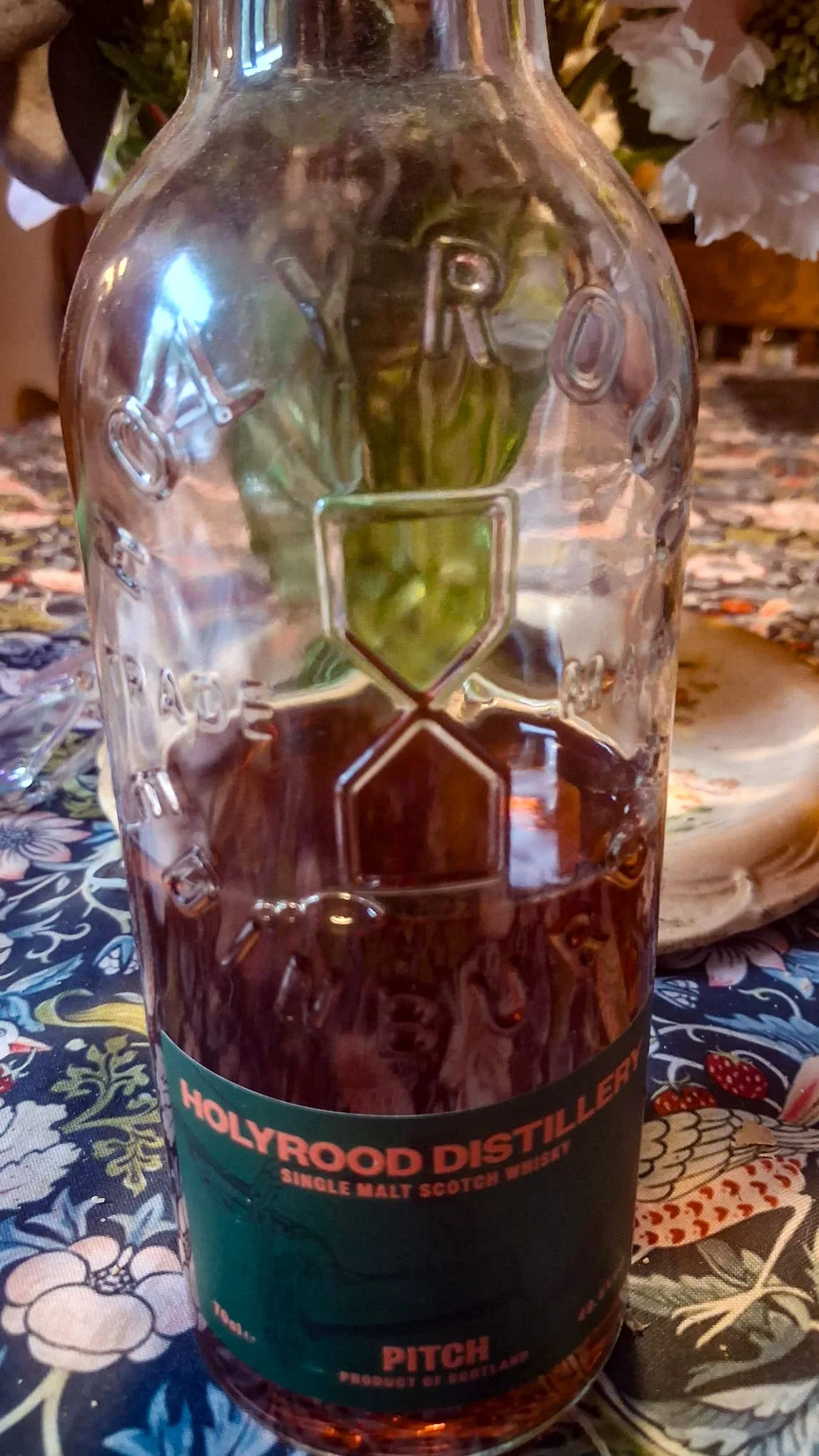
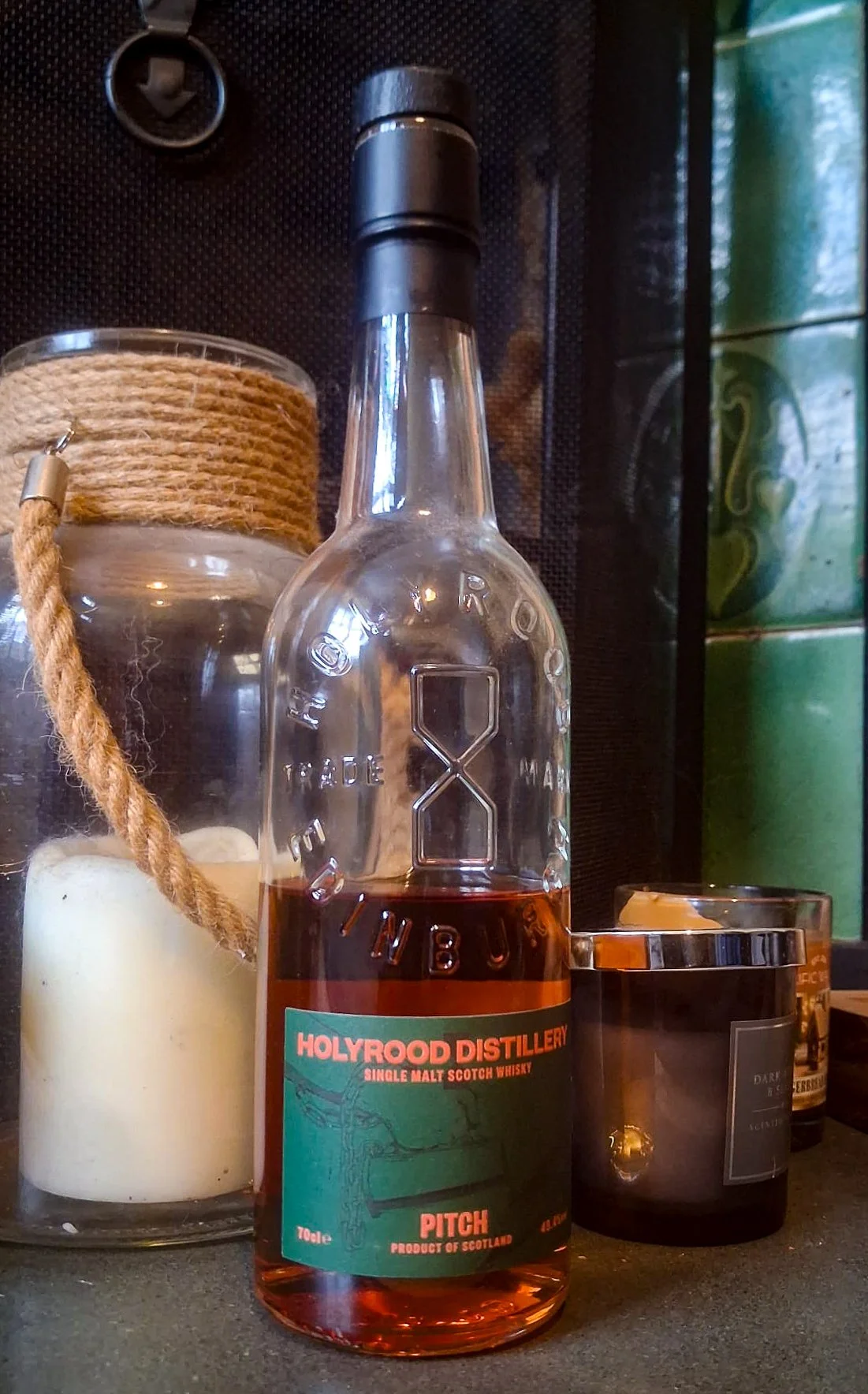
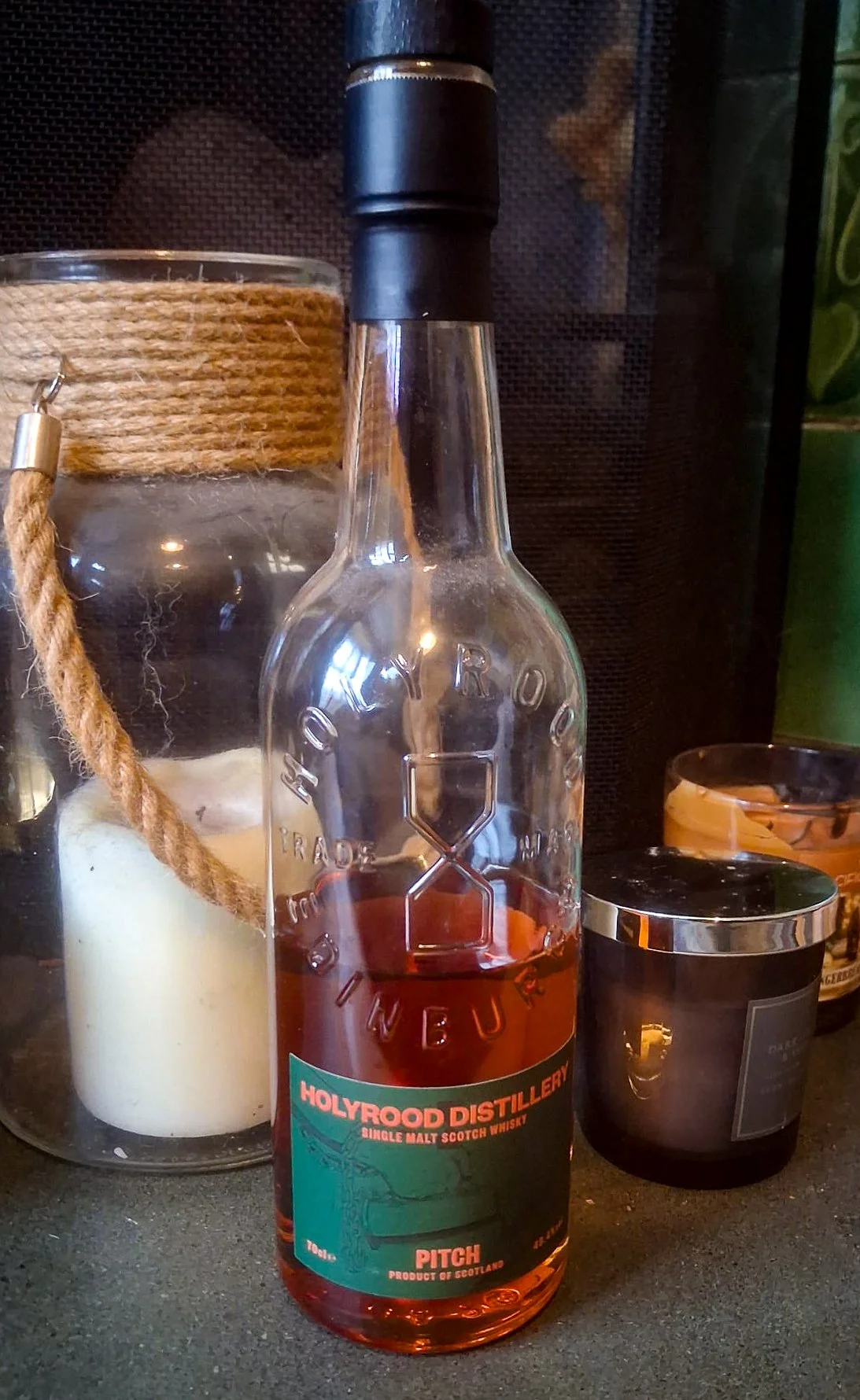
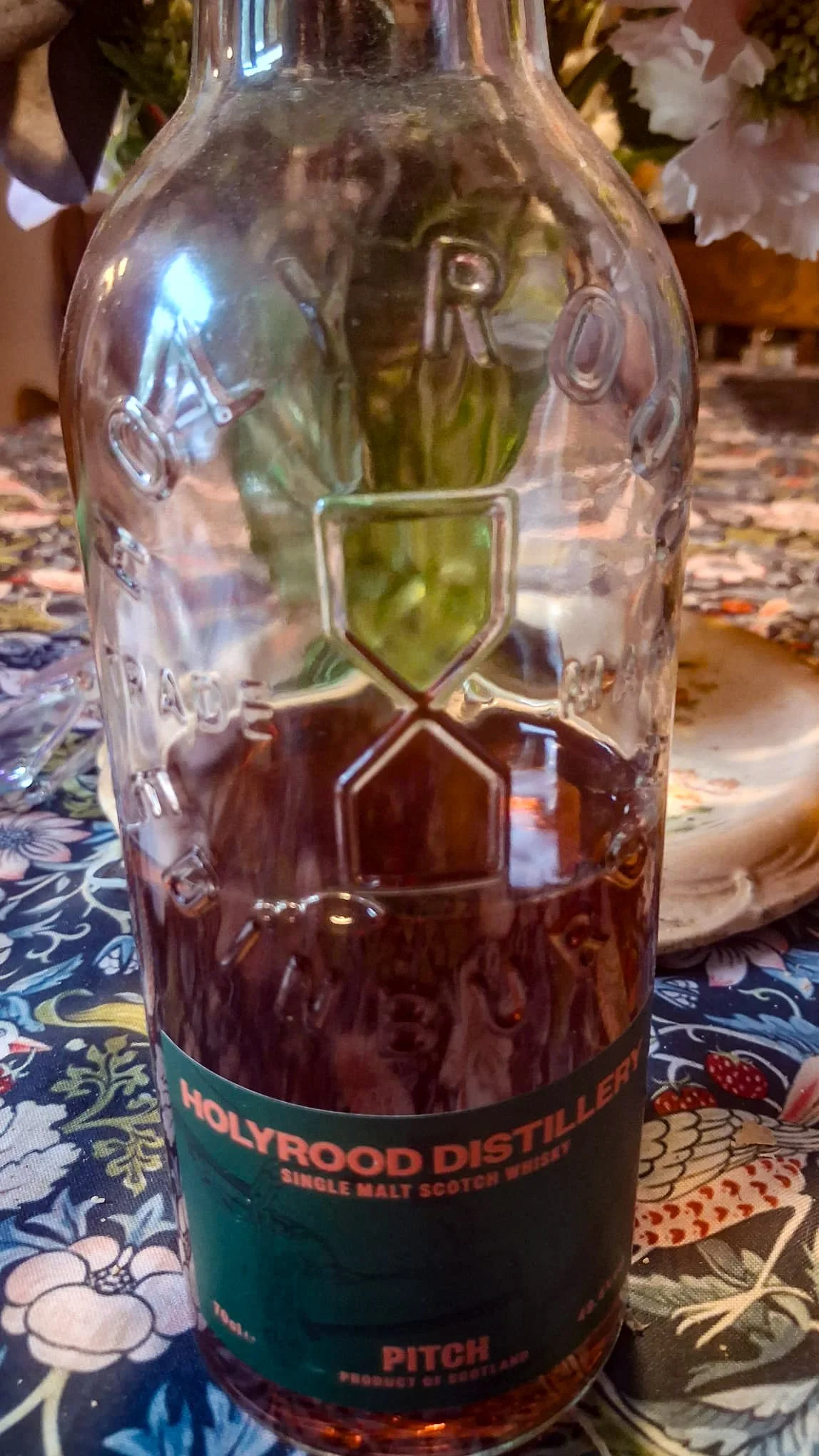
The whisky in question? Holyrood’s Pitch – an NAS expression that’s still available for around the £60 mark. There’s scant detail on the bottle, but according to the Royal Mile Whiskies website, this one’s been aged in sherry casks.
Nothing too unusual there, then. In fact, on paper, it’s a fairly unremarkable expression… until you start to dig a bit deeper.
Review
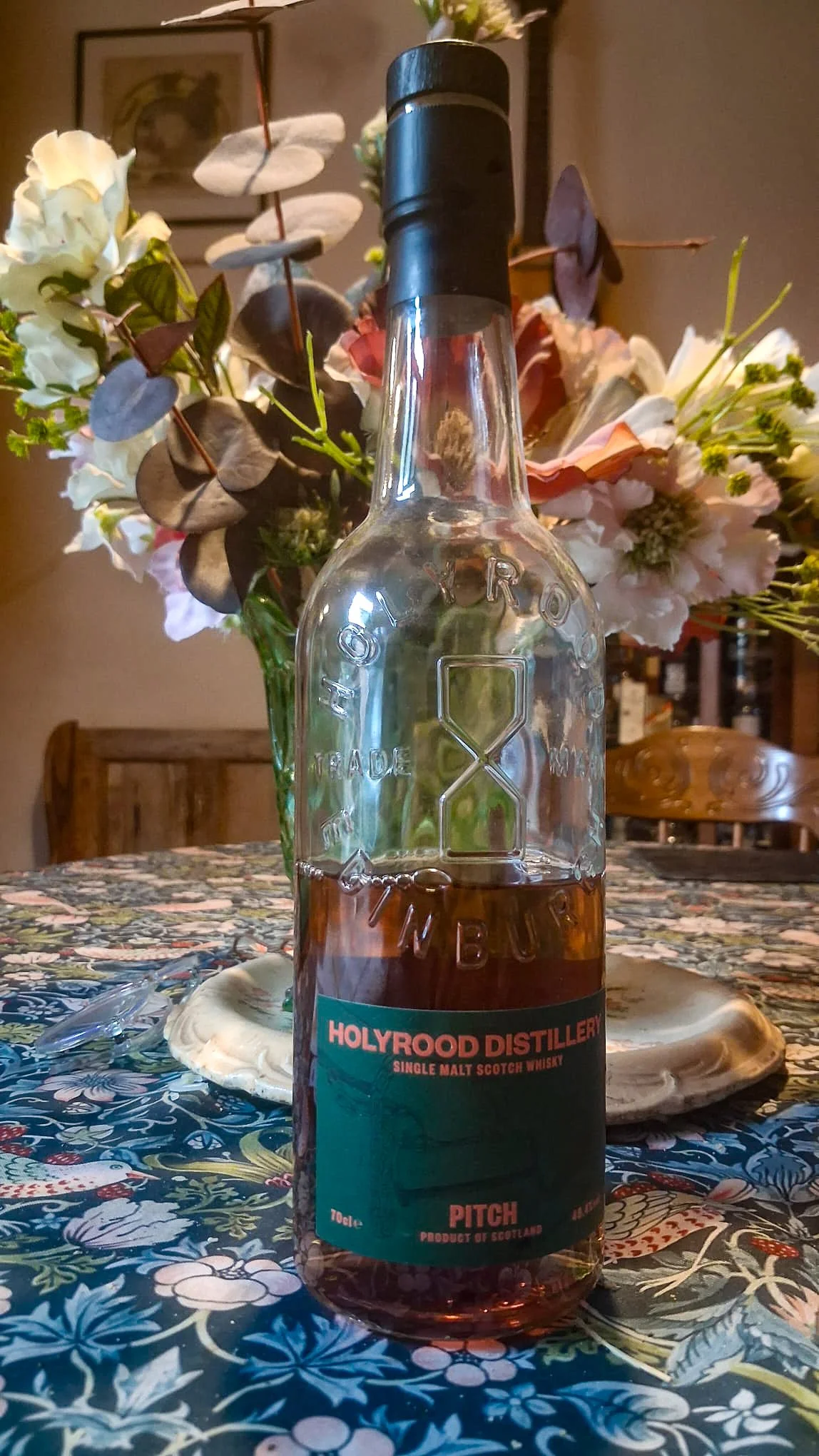
Holyrood Pitch, Lowland Single Malt Scotch, Official release, 49.4% ABV
£60 paid & still some availability
Doing that digging – i.e. Googling – reveals that this whisky has been made using Scotch pot malt and brown malt, as well as Pepe Nero and Toro Nero, two yeasts which are commonly used in red wine production. Brown malt is also commonly used for making porters and stouts and typically adds a chocolatey note. This makes sense, because there’s definitely something dark and chocolatey about this one.
That doesn’t quite do it justice, though, because as I’ve already said, this is unlike anything I’ve tasted before. It’s rough around the edges, sure, but it’s also completely unique; something which, in its own way, makes this one very compelling indeed.
You don’t have to take my word for it, though. This one’s been reviewed on Dramface before, by our very own Felix in his debut piece back in May 2025.
Score: 6/10
Good stuff.
TL;DR
Rough as a belt sander and utterly singular
Nose
Chocolate. Loads of chocolate. Malty and rich, like sticking your nose into a mug of Ovaltine. There’s also wood smoke, smoked meats and a slightly mushroom/umami type note.
Oh, and it’s rough. The first sniff singes the hairs in your nostrils and you know right away that you’re going to need plenty of water.
Palate
And need water you will. Without water, everything’s masked by the alcohol. You can add two, three, maybe even four teaspoons of water to this whisky and it’s still full of flavour.
A bit of water brings out a lot of chocolate – dark chocolate – as well as some demerara sugar and some coffee. Those are typical of the notes you might find in a review of, say, an Edradour or a Glendronach, but this one’s dark and chocolatey in a much, much more striking way. There’s also an earthy, umami quality about it – I get mushroom broth, smoked meats, toasted nuts and tobacco.
Underpinning it all is a slightly burnt taste. Maybe it’s from some sort of cask char? I don’t know. All I know is that the tasting notes I’ve just described don’t really do this justice. You have to try it to really appreciate how different it is (although I’ll caveat that by saying that this is a Marmite whisky, if ever I’ve tried one).
The Dregs
In a similar vein to Felix’s piece on this last year, when I think about the descriptors that I typically use when talking about whisky, I often fall back on familiar things. Like ‘nuts, figs, dates and raisins,’ (ex-sherry cask matured whisky), or ‘vanilla, toffee, lychee, pineapple,’ (ex-bourbon cask matured whisky), or ‘don’t really like it but it tastes of wine’ (ex-wine cask matured whisky). How much I enjoy a particular whisky depends on many different things, but often it’s a question of how well these various elements are balanced, which elements are apparent, and whether the mouthfeel, the price, or the ABV are solid.
Trying to characterise this particular whisky is difficult then, because whilst the mouthfeel, ABV and price are all great, it is genuinely unlike anything I’ve ever tasted before. It’s nutty and it’s chocolatey and it’s earthy, but simply using those adjectives doesn’t quite capture the uniqueness of it. I appreciate that I’ve said that word – unique – several times already, but really, unique is the only word that does this expression justice.
Where it falls down, in my opinion, is its age. I have nothing against young whisky, but let’s be honest, young whisky is often a bit rough around the edges, and this one’s no exception. When I say rough, I don’t mean rough in an elemental sort of way, either, like a young Caol Ila might be. Instead, I mean rough as in it might burn your tongue off, rough. It isn’t for the faint-hearted, this one, and if you’re a card-carrying member of the ‘it’s-a-sin-to-add-water-to-a-whisky’ brigade, then you’ll probably want to skip it.
If you’re happy to play with water, though – and if you don’t mind young, ‘rough around the edges’ whisky – then there’s a lot to recommend. It’s one of those whiskies that I’d pour for people who I know already enjoy their whisky; it’s abrasive enough to put off a newcomer, but singular enough that if you’ve been there, done that and bought the t-shirt, you’ll almost certainly find something to enjoy.
As for my own enjoyment of it, I like it a lot… but it’s not one that I reach for very often. Different is, of course, a good thing, but it’s not every day that you want something completely different, and despite my effusive praise, this one has sat in the cabinet for a while now, with the fill level going down slowly.
That being said, I’m still glad I bought it. At 49.4%, it’s well presented, the mouthfeel is lovely, and the price is fair. Holyrood deserves to be commended as well – in a world of safe, overly engineered, middle-of-the-road expressions, that don’t push the boat out; they’ve dared to be different. On that basis alone, they’ve done something that deserves recognition.
My only hope is that they’ll one day release something like this with a bit more age to it. I’d love to try a 10yo version, for instance. Or even an NAS expression which has some older stock in it to round off some of the jagged edges.
Still, for the price, I’m not complaining. Young and rambunctious as it is, this is still a very solid, engaging and interesting single malt. Oh, and did I mention that it’s utterly unique?
Score: 6/10
Tried this? Share your thoughts in the comments below. FMc
-
Dramface is free.
Its fierce independence and community-focused content is funded by that same community. We don’t do ads, sponsorships or paid-for content. If you like what we do you can support us by becoming a Dramface member for the price of a magazine.
However, if you’ve found a particular article valuable, you also have the option to make a direct donation to the writer, here: buy me a dram - you’d make their day. Thank you.
For more on Dramface and our funding read our about page here.

What’s your own personal top distilleries?
At the point of this article’s publication, Holyrood doesn’t appear in the Dramface Top 40.
You can influence that vote here!