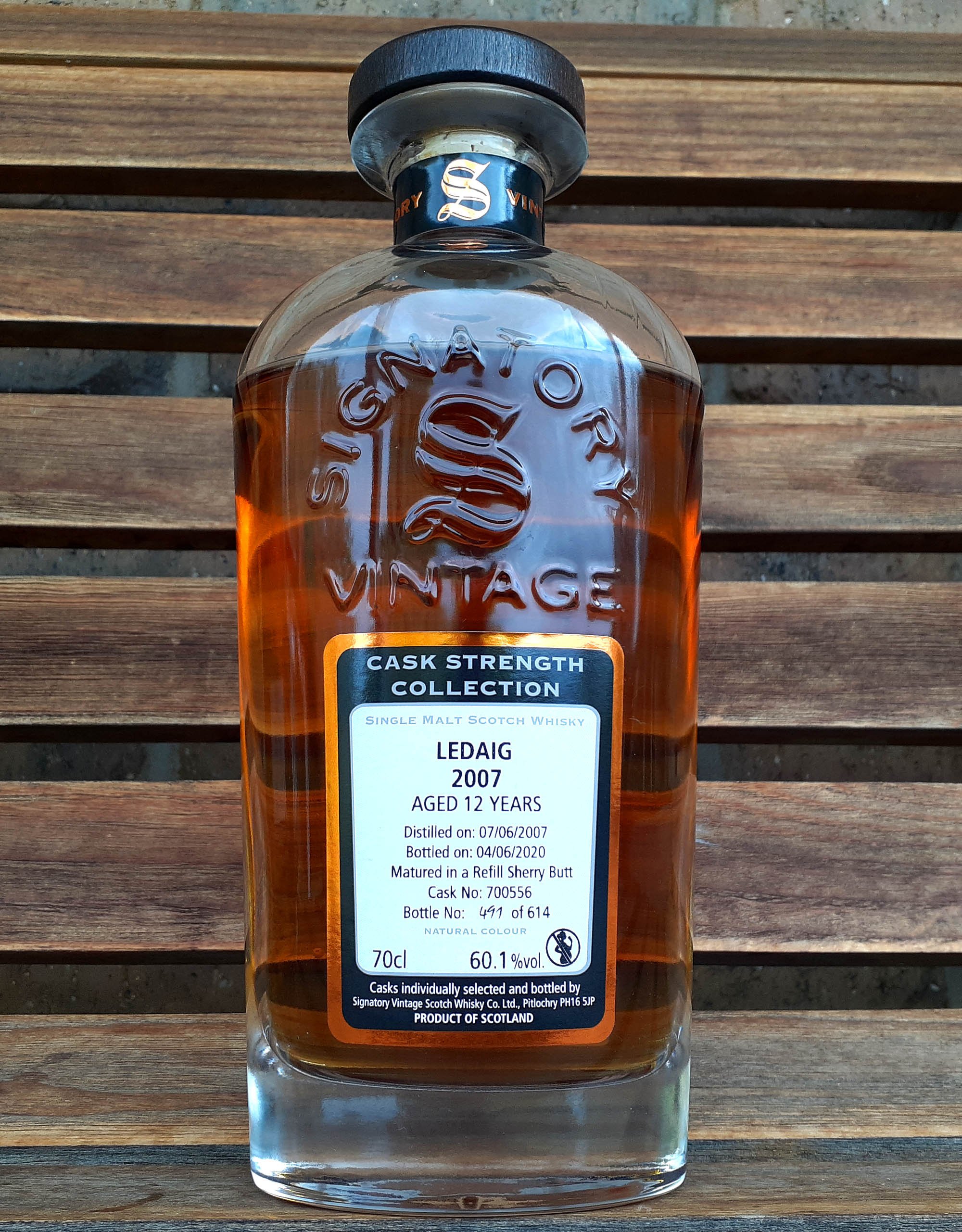
Cask Strength 2020 Release | 60.1% ABV
Score: 8/10
Something special.
TL;DR
This is why we love dirty whisky.
Not For Everyone?
Ledaig seems to be getting bottled more and more by independent bottlers of late, and I’m quite a fan of this distillery’s raw, farmhouse-like profile. That said, many bottlers seem to be releasing them out of delicate or tired casks at a young age, so many releases don’t highlight this wonderful spirit with quite the verve I would love to see. That being said, the Online Scotch Whisky Awards gave Signatory Vintage some fine plaudits. And with bottles like this that’s little wonder.
Ledaig in its modern form frequently executes a composition unseen in its coastal compatriots. To this meagre palate, it’s heavily peated, but less medicinal and cresol-driven than Laphroaig or Ardbeg. It’s farmy and has a fermentary quality that’s close to, but not analogous for, the oft-described “lactic” tones we might associate with Bruichladdich. Nor is it as powerfully phenolic or malt driven as many Lagavulin or Bunnahabhain Staoisha/Moine releases. Yet with the exception of Bruichladdich using Highland peated malt, they all source the same peated malt. So what gives?
Well, I don’t work for Distell, no matter how many desperate invocations one might employ, so speculation must abound with perhaps mild apocrypha in tail; be warned. To my mind, it’s likely that which gives so many distilleries their house styles; mashing and fermentation. If you’ll indulge me, let us take a detour to try and bust open this whisky mystery.
While we have little access to the fermentation regimes (yeasts, temperature ranges etc.) employed at Tobermory, there are widely quoted figures for fermentation length as 50-100 hours. Now that’s quite a span; many lactobacillus strains don’t really get started until around 35-40 hours into fermentation where we see exponential colony growth. Lactobacillus fermentation is well documented as being responsible for the production of many organoleptically significant fatty acids and as precursors to various aldehydes and esters. The sweet spot for a few of them really getting worked up is around 70 hours in. This is largely due to the bacteria having to wait for the yeast cells to finish primary fermentation, then autolyse and offer their intracellular goodies as nutrition for the bacterial cultures.
We are also given that Tobermory uses four Oregon pine washbacks for their fermentations, and it’s well documented that even with steaming, the porous nature of wood makes an ideal vessel for prior fermentation cultures to re-inoculate subsequent washes. Think of this as a built in sourdough starter of sorts.
As an aside, if anyone remains curious about the interplay of lactobacillus and fermentation for whisky, there is a brilliant article about it on the National Library of Medicine website.
So, if we take Tobermory’s fermentation lengths to an average and factor in a good likelihood for consistent lactobacillus culture inoculations via the pine washbacks, then we may expect to see good lactic culture blooming at the tail end of fermentation.
Another factor to consider is the mash tun. Tobermory is one of very few distilleries still using a cast iron mash tun. Some others we may keep in mind are Springbank, Glen Scotia, Bruichladdich and Edradour. Are we seeing a pattern in style here? Regardless, how much influence could this actually make?
Well, while we have no specific data to look at in this instance, we do have evidence demonstrating the relationship between iron and other redox-reactive metals as oxidising agents for lipids in complex biological systems. In wash production iron is responsible (among other things) for the production of fatty acid radicals. The peroxidation of lipids have aldehyde end products which may be further oxidised biotically/abiotically under acidic conditions, such as those in fermentation, into fatty acids. In either case, I promise I haven’t gone completely off my meds.
We haven’t even brought up distillation theory yet, but given I have been unable to find significant materials for Tobermory’s distilling regime, we’ll save that rabbit-hole for another day. So ultimately, what is my point?
Ledaig’s spirit is unique. We can only guess and make assertions as to how and why, but there are clearly factors at play that make it inherently different from other malts from Islay or the mainland. And this is good.
“I won’t say a word about Tobermory’s Ledaig. It’s an insider’s whisky, you know, and few people seem to understand that it’s simply blowing many famous Islayers out of the water these days. Shh…”
Review
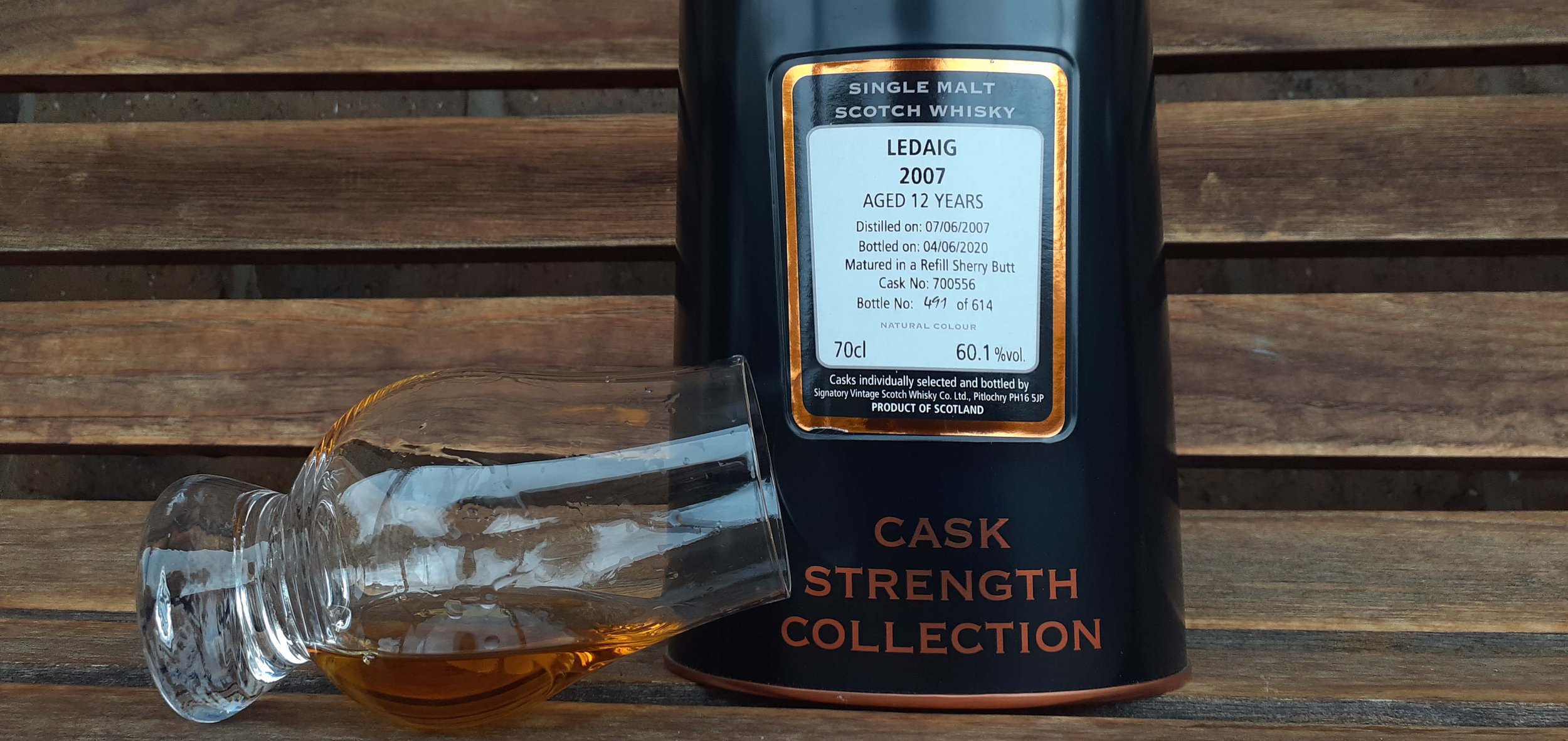
Signatory Vintage Cask Strength Series Ledaig 12yo 2020 Release, 60.1% ABV
£125, AUS$220 - sold out
As stated above, Signatory seems to be getting a pretty good rep these days. I admit to being one of its many fans, and of the bottles I’m likely to buy without having first tasted, a Signatory from one of my preferred distilleries is pretty high up the list. My only complaint is they can be a little heavily priced here in Australia, but it’s a small complaint compared to the quality they seem to be consistently offering, and in the grand scheme of whisky price inflation it’s probably only par for the course.
When I first considered buying this bottle, I held pause for a moment; sherry casks are much more temperamental and unpredictable than bourbon, and I’m quite picky about how I enjoy the interplay of peat and sherry. Also, for a refill butt at 12 years old, this has quite a full colour which we know to be natural. Could this release be over-extractive?
But this is where the reputation of a good bottler and the experience of similar palates comes in. After some reassurance from friends that had tasted similar era, age and maturation style Signatory Ledaigs I felt compelled to pull the trigger.

Nose
Almost sadomasochistic. Engine grease, coal dust, semi-medicinal embrocations, oily kippers, lanolin and Vegemite, which is to say something autolytic - a fermentation quality which works nicely here. With time some of the more tertiary aspects creep out; pyrazines a la roasted coffee, boot polish, oxidative sherry - think walnuts and salt - with some earthy barn yard funk and soft fruit leathers.
Palate
As with the nose, a bludgeoning of pleasure. Various smoked fish and their oils, soot, tiger balm, that earthy/farmhouse funk again, touches of anejo mezcal, lemon oil, more walnuts and generally a bit sweeter oloroso than the nose indicated. Peat, fermentation and cask balance on a razor’s edge. Retronasal offers wood smoke and more pyrazines, this time geared closer to bird’s eye chilli plus pepper. The finish brings in chargrilled sticky BBQ pork with dried red fruits.
The Dregs
In my mind, Ledaig enters a small pantheon of other dirty whiskies that when handled properly becomes sublime. Hint: most of the others are found in Campbeltown. I’ve had this bottle for almost a year now and this is perhaps my fourth dram from it. Every time I’ve poured a glass, I can’t help but think: “Surely this isn’t as good as you remember it?” And then I pour a dram to enjoy over the course of an hour or so, following as it shifts between featuring oiliness, peatiness, dirtiness and all its many subtleties. Inevitably the bottle goes to the very back of my collection and I reprimand myself. This is a special whisky for savouring, and not to be drunk lightly.
Again, accolades must be given to Signatory for putting this together. Unlike many other bottlers, they seem quite content not to stick some whacky finish on their malts for the sake of marketing. Ledaig’s spirit does so much of the heavy lifting, it should be classified as a “less is more” maturation style in my opinion.
With that said, I don’t know when we’ll next see a similar Ledaig release, nor which bottler will release it, but I’ll be damn sure to hunt it down. That’s ironclad!
Score: 8/10
Tried this? Share your thoughts in the comments below. TK
-
Dramface is free.
Its fierce independence and community-focused content is funded by that same community. We don’t do ads, sponsorships or paid-for content. If you like what we do you can support us by becoming a Dramface member for the price of a magazine.
However, if you’ve found a particular article valuable, you also have the option to make a direct donation to the writer, here: buy me a dram - you’d make their day. Thank you.
For more on Dramface and our funding read our about page here.