2022 Release| 58.7% ABV

Score: 7/10
Very Good Indeed.
TL;DR
Unique, terrific and coastal!
They Say There Are No Wrong Notes In Tasting Whisky
But do they mean it?
I wanted so much to write about the quickening whisky alchemy at play over there on the Ardnamurchan peninsula, but there will be many opportunities for that in future, I’m sure. This time, I’m prompted by the whisky in my glass to think about our interpretation of flavour. You see, this whisky is a coastal whisky. It just is. It’s made near the sea and it’s matured near the sea. How much does that impact the flavour in my glass tonight? I don’t know, genuinely, but I feel like it’s a lot.
I think many of us have been at that tasting; the one where we’re encouraged to share what we smell and taste. They’ll reassure us it’s fine whatever we say – nothing is wrong. We get what we get. Just say it.
I think it’s the right thing to do. It’s especially effective in a small group, where you can bounce notes back and forth and help each other unlock and label aromas and flavours from the glass. When the company is convivial, it’s great fun. Yet often, the same folk who encouraged you to speak out will later explain how some of this is, in fact, wrong.
For instance, you may hear that whisky can’t actually be salty. It isn’t always matured by the sea and, even if it is, salt crystals cannot pass through an oak cask. You pause, realising that makes sense. But you taste salt, right? Certainly, if you look at my tasting notes for this belter of a whisky, you will most definitely read ‘salt’. It’s there. I won’t hear otherwise. I don’t know why it’s salty and I accept those crystals do not have their passports stamped by the customs officers at the gates of oak. Yet, it is so.
I also taste lemons. And seashells. And honey, and rocks, and peppercorns, and I taste a beach fire. I suspect they may have even more trouble negotiating their way through the oak border control. So perhaps the more we try to science away this enigmatic and fickle liquid we love to interrogate, the more we miss the point. But before I just give in to the whimsy and romance of it all in typical Wally fashion, let me ponder this science a little more.
“All of these things are intriguing to me, not because of the reasons why or the reasons why not, but because I can actually taste them.”
We’re told the liquid in your bottle is remarkably stable. It’s more-or-less the same from opening to finishing, apparently. Yet you and I know differently, don’t we? We know that it most certainly is not. Now, the whisky in question today was great from the freshly-popped bottle, but I assure you that now it’s been thrown around a little and shared here, there and everywhere, it has become nothing short of epic. It has changed, as they mostly do, for the better. Other than simple evaporation, I’ve never found the science to explain it, yet, but time after time it gets better. Usually somewhere just beyond the shoulder.
Likewise, if you’re ever fortunate enough to open and enjoy antique bottles of whisky, those that have remained sealed for a couple of decades or more, you’ll start to notice a thread of commonality in many of them. Despite differing styles of whisky; different malts and different grains, they often take on a similarly fusty, slightly damp cellar note that can – oddly – work quite well at times. It’ll often be accompanied by a rounded and silky arrival that would have you believe that the whiskies of old were much softer and of much higher quality than those of today. They very much could have been, but without a time-machine, we can’t know. In this example, what we may actually be experiencing is old bottle effect; the product of years of ‘ageing’ in glass – revealing more truth that this chemical soup we call whisky is only relatively stable.
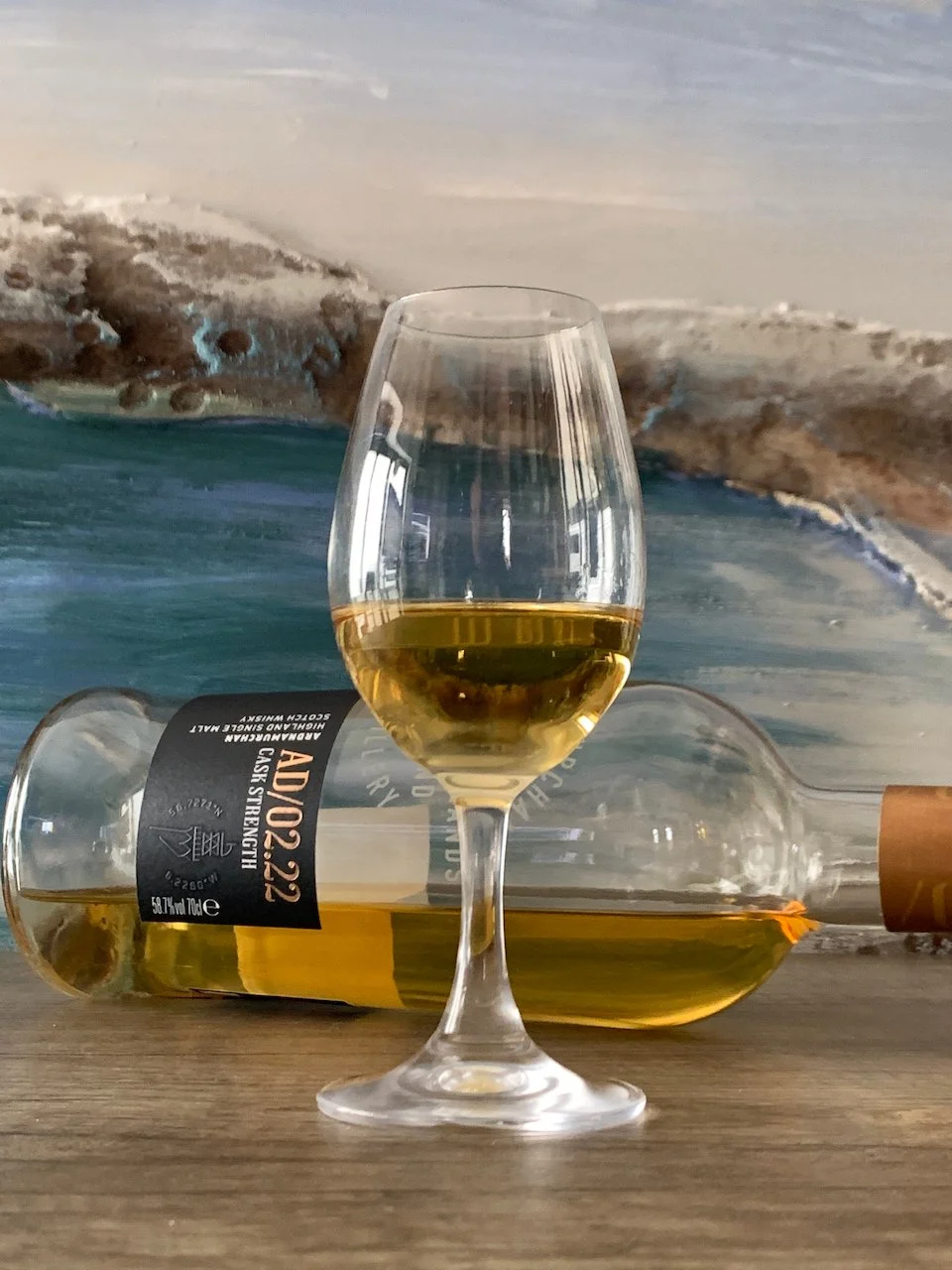
What’s in the glass? Salt, lemons, and kicked beach fires. And more.
All of these things are intriguing to me, not because of the reasons why or the reasons why not, but because I can actually taste them. Even if a lot of that taste is in my head – I care not – I can taste it. Explain it away with any science or debunk as much as we like, if we taste it – it is so. That should be encouraged, especially when we enjoy it.
Like everything in whisky – or anything subjective really – when we hear or read an idea, not only should we take it with a pinch of that very same salt we can-or-can’t taste, we should ask something of the source. What’s their perspective, or more importantly, what’s their motivation for these words? Do they need us to believe it’s so? Does it fit their theme? Their line-up? Their own ideas? It’s like everything else in life; it’s usually courted because it fits a story or a need. Which is mostly okay. It just needs the application of individual, rational intelligence.
Here’s an example which I think fits nicely. There’s at least one prominent industry figure, now retired, in Dr. Nick Morgan, who suggests that, as long as it’s in Scotland, it matters not where scotch malt is matured; close to the coast or inland because all of Scotland has a maritime climate. It’s therefore not particularly relevant to the maturation process. I’m really not sure I agree here. Rather than thinking about the effect of maturation locale on casks, we’re directed to think about Scotland’s general climate, which are very different topics. But anyway, when I travel to the coast, I often taste salt in the air. Once, after a stormy night, I noticed a misty film on the roof of my car. I may have run a curious finger through it and I may have curiously licked it. I can tell you it was salty. Now, I live in Scotland’s central belt; I do not taste salty air, and I have never found a salty film on my car or anything else, stormy nights or not. It’s not far, as the crow flies, from Wally’s whisky pit to the coast, but it’s very different nonetheless.
So, applying a little of that rational thought, it makes sense that these words would come from someone who is ex-Diageo. This climate observation fits the corporate whisky narrative. When the majority of casks are matured centrally I think it’s no doubt helpful to have a climate factoid to wave like a dismissive wand and banish one of the potential negatives of centralised warehousing. I imagine in his long career, Morgan has had to field this question from many curious whisky geeks. He may be absolutely right, and if you’re going to pick someone to listen to on these things you’re no doubt better off listening to Dr. Nick and his vast experience as opposed to Wally and his, erm… eager but much more domestic and lesser experience. But I think my point is that perhaps you should listen to both, before listening to yourself.
Now, I should add that I am not saying Dr. Nick doesn’t taste salt in whisky. These are different things. But as we go along our whisky journey, continuously learning, you need to trust your own discoveries while staying receptive to all available opinions in order to help refine your own. If you taste salt in whisky, you really do. If you feel a preference for whiskies that have some provenance to their maturation and you find they may even display a characteristic of that provenance, then you are absolutely right. I often hear from – or speak to – people who are reflectively lamenting how they cannot yet define aromas, flavours and other things (such a provenance) in whisky. If that’s you; indulge me – and yourself – start to address that right here on Dramface.
Try to turn this – or any write up or review – into that aforementioned tasting. With the matching subject bottle of malt on hand and the appropriate place and moment to do so; pause for a moment. Interrogate the whisky first, writing down what you discover. Don’t force it and don’t invent things, say it only if you find it. Even if it’s only one note. Even if it’s a wisp. If it’s there, it’s there. Then read the tasting notes. Do it here or anywhere in the Whiskyverse. I think it could be the best fun you’re not yet having in whisky. Through this, you’ll be pushing your way forward and opening up your palate to new capabilities and your confidence will grow. You won’t need reassurances that you’re ‘not wrong’, and you’ll be far better armed to take Wally’s, and everyone else’s, opinions on everything whisky with a pinch of that salt.

Review
Ardnamurchan Cask Strength AD/02.22, 58.7% ABV
£65 still available here and there
This bottle was compelling from the first pour. However, as with many, this is a ‘second pour’ whisky. I casually enjoyed a tiny nip of this neat, before deploying the blender’s glass alongside a second parallel pour in a copita. I had a lot of fun trying to tie down what makes this unique. Adding water (to the point of too much for normal purposes) helped things along. I added the water slowly and the whorls in the glass kicked up a maelstrom before settling to a natural, cloudy and calm yellow. As I searched both glasses I was transported to the shores of Scotland’s west coast, and I realised this is the happiest I’ve been writing up notes for Dramface. Hence the preamble you’ve just endured.
Nose
Cracked peppercorns and salted lemons, a hint of zest and mineral fizz, like Alka Seltzer. After settling, some set honey and oak notes appear alongside a little moist pouch tobacco and eucalyptus. From the power of suggestion (once received during a hosted tasting), I find those crushed seashells I look for in every Ardnamurchan. All of this with a heady backdrop of warm spices over a doused-and-kicked beach fire.
Palate
Rocks and oyster shells prevail after a spiced and honeyed arrival. The fruit here is fresh citrus and occasionally sharp; think sweet pink grapefruit. White pepper, ginger, menthol and eucalyptus give this a sense that, especially with a little of that Alka Seltzer effervescence, this would make a great hot-toddy. The finish is drying and moreish. A second glass encouraged the addition of a few drops of water, then a few teaspoons. It softened things out nicely while clouding over to a coastal mist in the glass.
The Dregs
This is terrific, and unique, malt whisky. I think it’s at once distinctive and yet troublesome to tie down and articulate. One moment it’s big and jagged with layers that slowly peel away, like a rusting hull on sea-smashed rocks. The next it’s gently fizzy and transient like dissolving beach-surf. With diligent effort, I was able to forcibly distract myself from the blender’s glass to scribble out some notes.
This is, I think, the most heavily peated Ardnamurchan I’ve spent any time with. I also think that, while unique, in many ways it’s reminiscent of good Talisker. All I know for sure is that I taste these things, that it’s as moreish as hell and I was very lucky to get another – delivered this very day – from Master of Malt. It’s still out there. I hope, if it’s your wish, you find one too. This is the kind of release that makes me excited about the future of whisky and all the flavours yet to come.
For laffs - scan the QR code so Adelphi can beat you silly with transparency. My bottles are 80 & 224 - what are yours?
Score: 7/10
Tried this? Share your thoughts in the comments below. WMc

Clyde’s Tasting Notes
Nose
Before firing into this feisty cask strength dram, I left it in the glass for 20 minutes - and the bottle fill level has just cleared the shoulder. Salt and pepper straight off the bat, followed by soy/hoisin sauce - definitely something umami going on here. I also get roasted poblano peppers, but there’s also a sweetness over the top. A whiff of cappuccino chocolate and there are definitely fruits swirling below the depths: honeydew melon, lemons and orange pith. There’s peat here, but the kind of peat which adds depth rather than a full-on smoke grenade. Cold ash, banana toffee, red liquorice laces, and, one for my fellow Scots… Lee’s macaroon bars. Water softens everything and elevates the fruitiness.
Palate
A huge shake of salt, black pepper and lots of prickly spices. It’s approachable, though, even at this high ABV. The sweetness from the nose is present, but not immediately noticeable - at least for me. There’s something akin to fresh jalapeno peppers and caramel wafers on the finish. Those spices are dancing. Note: Must try this with a curry! Water adds a little grapefruit and dampens those jaggy spice notes… only a bit mind you.
The Dregs (Clyde)
I’m a big fan of what the team at Ardnamurchan are up to. Their standard releases are always interesting and don’t tend to hang around long on the shoogly shelf in Clyde’s bothy - and that’s unusual for me as bottles usually last me ages. I first sampled this Ardnamurchan at February’s Glasgow whisky festival and I was impressed then. I’m very happy with my purchase, especially as I can now take my time and explore the full bottle. Yes, it has a few rough edges and it won’t be for everyone, but that’s what makes it interesting for me. It’s definitely a challenging malt but it has character and I’m sure as the fill level recedes, more surprises will make themselves known.
Clyde’s Score: 6/10 CS
-
Dramface is free.
Its fierce independence and community-focused content is funded by that same community. We don’t do ads, sponsorships or paid-for content. If you like what we do you can support us by becoming a Dramface member for the price of a magazine.
However, if you’ve found a particular article valuable, you also have the option to make a direct donation to the writer, here: buy me a dram - you’d make their day. Thank you.
For more on Dramface and our funding read our about page here.