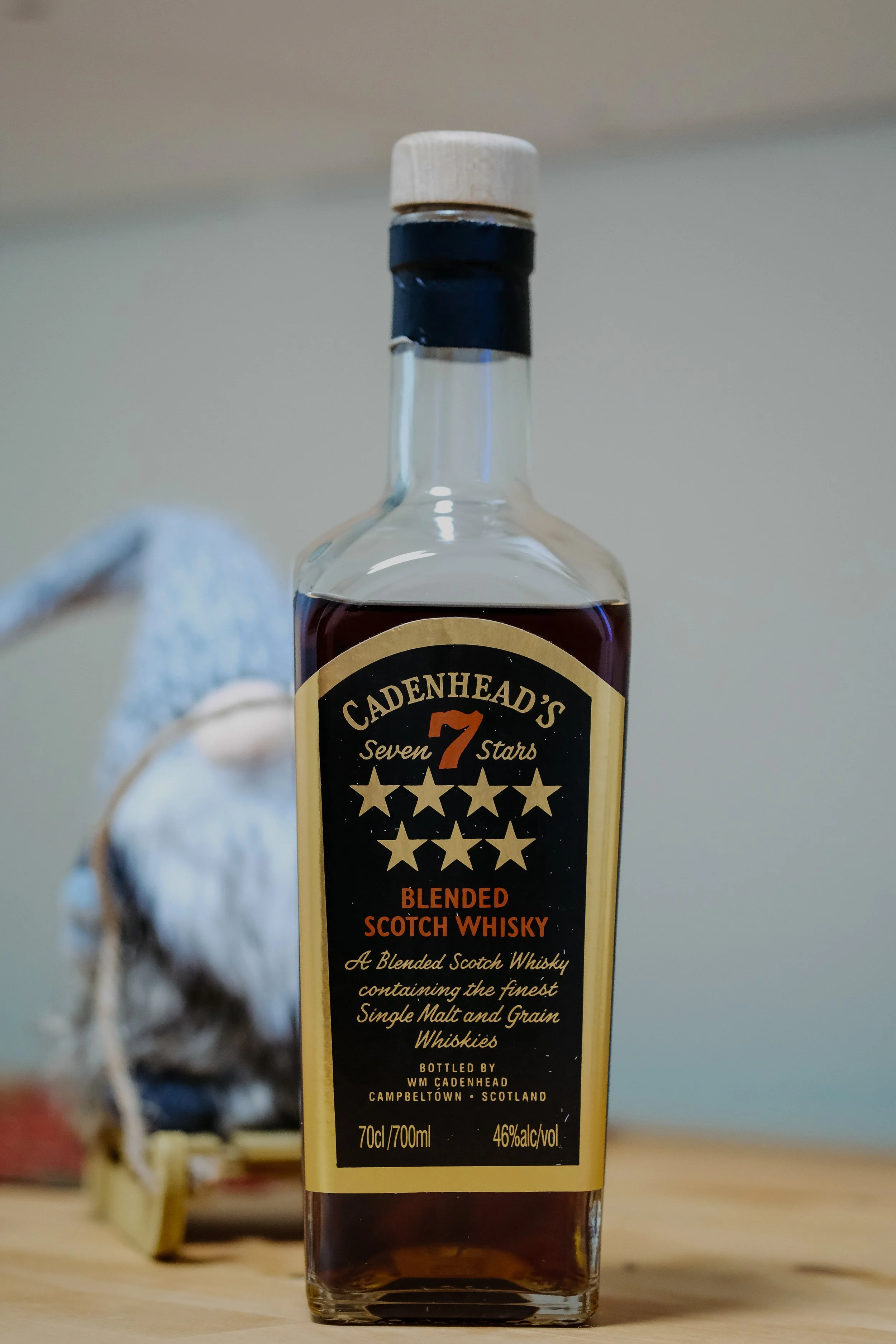
Cadenhead’s Seven Stars
Blended Scotch Whisky | 46% ABV
Score: 7/10
Very Good Indeed.
TL;DR
Stunningly rich, except on the wallet
You Asked
Numbers. Numbers. Numbers - now with a dash of Dramface personalities tossed in.
I recently did a high-level overview of some Dramface statistics (as of October 31, 2025) while mulling over an excellent SMWS Loch Lomond and everyone chimed in the comments that a peek under the hood was fascinating. Well, that was all the primer I needed.
This snapshot includes a few more whiskies as I’ve extracted the data as of November 30, 2025.
This time I’ve decided to delve a little further into the data, rather than the topical coverage in the previous review. We are very focussed on transparency here at Dramface. Transparent when a sample or bottle is provided to us for review. And we should also be transparent with our scoring tendencies and any subliminal biases or preferences.
With that in mind, I’ve decided to provide some scoring breakdowns for some of the authors who have contributed significantly here at Dramface over the years. We are (I am) aiming at bringing some transparency to scoring across authors, preferences, and continents.
This is all for you and, as far as I’m aware, this is something that others ‘round the review circles don’t do. Please do not get the pitchforks out.
At Dramface, we don’t standardize scoring. To do so, we would need to ship samples around the world to various authors and let them independently, and best case, critique a whisky blind. Ideally, those whiskies would be from the same batch/bottle as well. The samples would also need to cover OB core range stuff from the “big guys” and also likely from the various regions in Scotland, likely need to consider some higher strength single cask offerings, and also include non-Scotch whiskies like Irish, Canadian, American, and perhaps some tropical stuff like Kavalan. Then on top of that, we would need to agree upon what each whisky “should” score and that turns into another challenge.
Personally, I think most core range official bottlings of the 10-12yo range, usually at the 40% range too, should be scored as a 4. My reasoning being that it wouldn’t be hard for them to release at 43-46% for I feel that the masses drinking 40% stuff are usually dropping it into a highball or a few cubes, and the additional ABV wouldn’t be overly noticed but would satisfy us more. But I can easily see how others might give them a 5 for those entry-level OB bottles as they could be “average”.
Now before we get into more charts and analysis, I’ll encourage you to read on about a banging blended Scotch. I honestly can’t believe we haven’t reviewed this yet.
Review
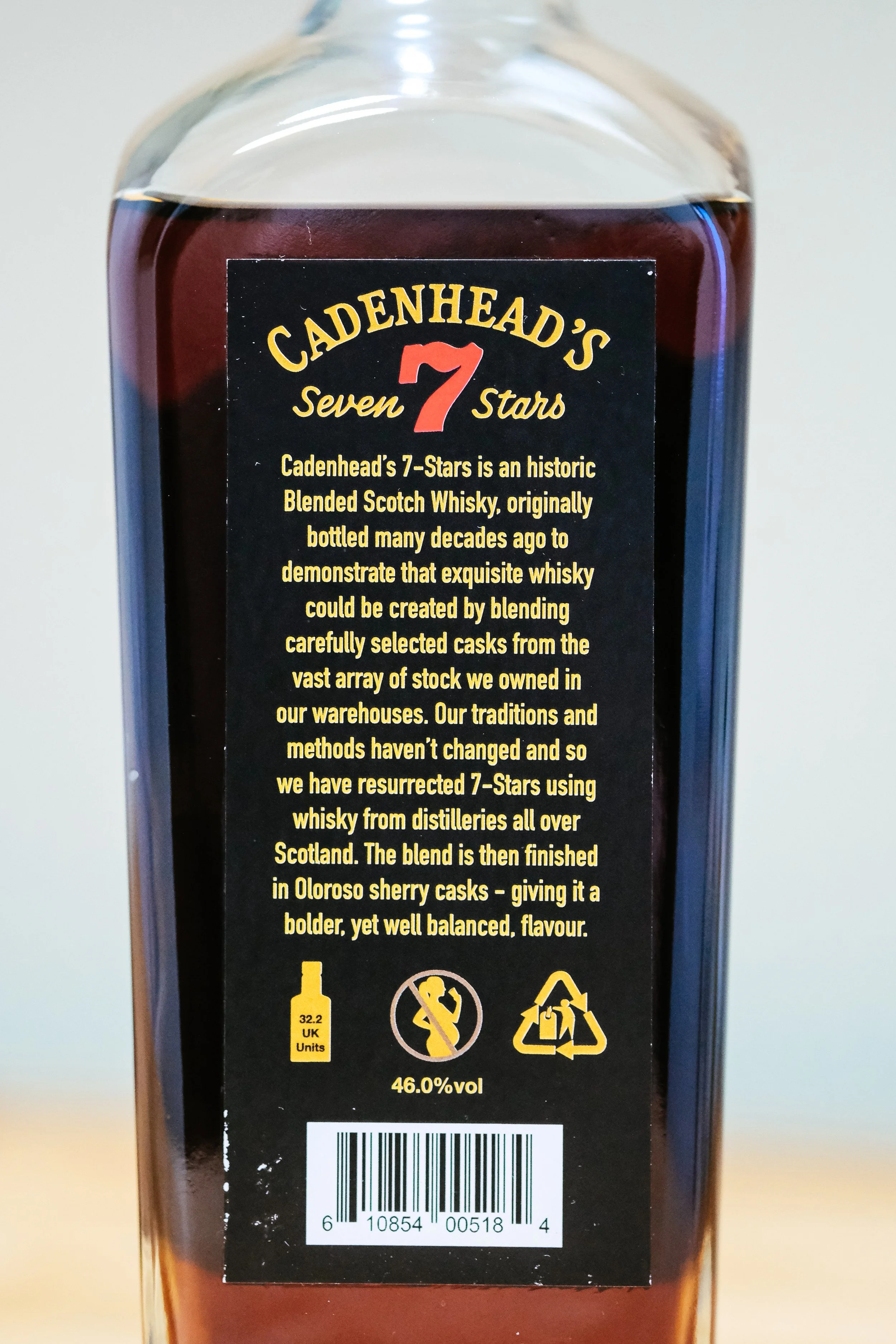
Cadenhead’s Seven Stars, Blended Scotch Whisky, 46% ABV
CAD$60 paid (£33) and available from Cadenhead’s
Score: 7/10
Very Good Indeed.
TL;DR
Stunningly rich, except on the wallet
Nose
Rich oxidized sherry. Leather, dried nut mix, raisins. Butter tarts. Virtually no prickle as well. This is something you can share with everyone.
Palate
Rich and sweet entry. Some peppery tingles. The butter tarts are here, with their rich brown sugar and buttery raisin goodness. Cooked dates. Distinct Oloroso notes of mixed nuts.
I’ve become something of a Scottish grain canary, able to pick it out when it’s a component. This blend artfully integrates the grain component, allowing it to occupy volume but not detract from the experience.
The Dregs
So while on the topic of NAS whiskies, we’ve reviewed a significant number of them here at Dramface. Of the 420 we’ve reviewed as of November 30, 2025, we have quite the spread in scores, a damn near perfect Gaussian “bell curve” shape, centered around an average of just over a 6/10.
A not so insignificant number of below 5 have been covered as well. I’d say we have a pretty good handle on these NAS whiskies, whether in single malt or blended form. This Cadenhead’s 7 Stars bottle slots in nicely as well.
If we compare the distribution of age-stated and NAS whiskies, we’ve reviewed more NAS whiskies than age-stated whiskies within a 4 year range. It appears that whiskies aged 9-12 years are our specialty, bracketed by younger and older whiskies. Interestingly, we have reviewed a significant number of quite young whiskies, many of which could barely be labelled as whisky! And it appears that we also don’t mind our older whiskies too!
Alright, let’s start diving a little deeper, especially for our age-stated stuff. Apologies in advance that this graph, and those coming up, are going to require some time for interpretation as we are starting to cram more variables together.
If we are looking for generalizations based on the arbitrary four-year bin range that I chose, we see that the younger 5-8yo (n=209) whiskies and our most commonly reviewed 9-12yo (n=363) whiskies follow the same distribution trend, with most falling around our Dramface average scoring of somewhere between a 6-and-7 out of 10.
However, we start to see the 13-16yo (n=194) whiskies achieving a higher scoring distribution trend, nearly perfectly centered about the score 7. And even older whiskies, in the 17-20yo range (n=76), are consistently earning scores in the 7-8 range.
I’ve neglected the younger and older whiskies because I felt that the number of datapoints (that “n” number I’ve been using) was becoming fewer and the data or trends would be less reliable from a statistical point of view.
So if you go back to my original data-centered review, you’d see that prices generally increase slightly with increasing score and now that we see that older whiskies generally result in higher scores, this all makes sense. We love it when the data lines up!
Ok. Now for the personal stuff, as promised. I’ve chosen to keep everything transparent, keeping reviewer names (well our aliases at least) in the data rather than anonymizing everything. And I’ve also split our top 10 producing reviewers into two groups to allow for easier viewing of the plots. I’ve only analyzed data where the reviewer was the first author on the review so for many of us that have been in the supporting act, those data points have been omitted.
In this first batch, we have our effervescent Dougie coming in at a stunning 175 first-author reviews to Hamish with 87 reviews. Starting at the top, we see that Dougie has a relatively narrow distribution centered at a score of 7 and few reviews of scores less than 4. This makes sense when we consider that Dougie’s elixir of choice is Ardnamurchan, making up 29% of his reviews (n=51). Critically, this means that Dougie’s preferences align with Ardnamurchan, giving him a bias towards a 7, but also allows you to judge your personal preferences against Dougie’s scores. Perhaps you don’t jive with Ardnamurchan’s distillery profile and releases and therefore you can compare yourself against Dougie’s tendencies in scoring accordingly when deciding to purchase a bottle on the back of one of his reviews.
When looking at my data (Broddy), I have a broader and flatter distribution. My scores are centered around a 6, with a near even count of 5’s and 7’s. Compared to Dougie and others, I’m the largest contributor to the score of 5 category, which according to our Scoring System, is theorized to be the average whisky and representative of today’s whiskies.
Personally, I know I purposely go about scoring a whisky by asking myself what adds or detracts from a 5 since it’s our supposed middle point. It’s my scoring centroid from which I base everything. Interestingly, I also have a near-equal distribution of 4’s and 8’s as well. It would appear that I use the full range of Dramface’s scoring scale, albeit not nearly as much as my fellow Colonial Tyree.
Tyree appears to have a right-biased distribution towards higher scoring stuff. However if we look at the lower end, he is not afraid of letting us know when a whisky is not up to snuff. Both Earie and Hamish appear to be near-identical twins of each other. It’s actually quite eerie (pun intended).
Aren’t numbers cool? Pretty sure one of your math teachers told you something similar at some point too.
Alright, now for the second half of the authors. We have Ogilvie (n=83) to Drummond (n=50), spanning continents and many decades of age and also whisky experience.
Reviewers with less than 50 published first-author reviews, have not been included for statistical reasons only. These reviewers are still incredibly important to us at Dramface, bringing their unique perspectives, but unfortunately the fewer total reviews coupled with the spread across 10 potential scores means that trends are going to be fraught with decreased certainty.
Arguably, 50 total datapoints is insufficient as well but I wanted two unique and consistent comparisons of reviewers (five each). From Ogilvie, we see a distinct tendency towards 6’s compared to others in this scoring comparison. He is also not afraid of throwing a few punches, with the highest fraction of 4’s, but interestingly the other authors, in particular Ainsley, are not afraid of dropping a 3 or lower score once in a while.
When Wally does contribute, which is not a shot but an acknowledgement that he has been around since Dramface’s inception, it would appear that he speaks out about whiskies that excite him and are of objectively good quality.
It would appear that Ainsley and Drummond are our second set of twins here. Who knew a Frenchman and an ex-Yank could be so alike? Ramsay appears to be a mini-Dougie as their distributions appear quite similar as well, albeit Ramsay appearing to be more promiscuous in his spending habits.
So there you have it. More Dramface dirty laundry. Or at least a level of transparency and analysis that is rare amongst people on the web. A simple sentence carries immense weight but I challenge you to share another site or platform providing this level of detail across this many whiskies.
Let me know if you want me to do more breakdowns in the future. I read every comment and every article posted here at Dramface so I’m sure I’ll catch it!
And back to this tasty blended scotch. Cadenhead’s smashed it out of the park. Buy it, just buy it. And enjoy it. And share it. And buy another. And share it again. This scores a 6.5 from me, and given the immense value proposition that this brings to the table, it’s a 7 from me, and now that you know my scoring habits, you can be the judge if it’s right for you.
Alternatively, just buy it and enjoy this OSWA-nominated whisky as I think it represents the new-wave of proper enthusiast-oriented semi-premium blended Scotches made with quality ingredients.
This new-wave, which includes the now long-running Maclean’s Nose and some of the original Compass Box blends like Orchard House, should be part of everyone’s shelf, cabinet, or bunker for they represent quality whisky and affordable prices.
Forget the single malt snobbery and embrace and share quality blends.
Score: 7/10
Tried this? Share your thoughts in the comments below. BB
-
Dramface is free.
Its fierce independence and community-focused content is funded by that same community. We don’t do ads, sponsorships or paid-for content. If you like what we do you can support us by becoming a Dramface member for the price of a magazine.
However, if you’ve found a particular article valuable, you also have the option to make a direct donation to the writer, here: buy me a dram - you’d make their day. Thank you.
For more on Dramface and our funding read our about page here.